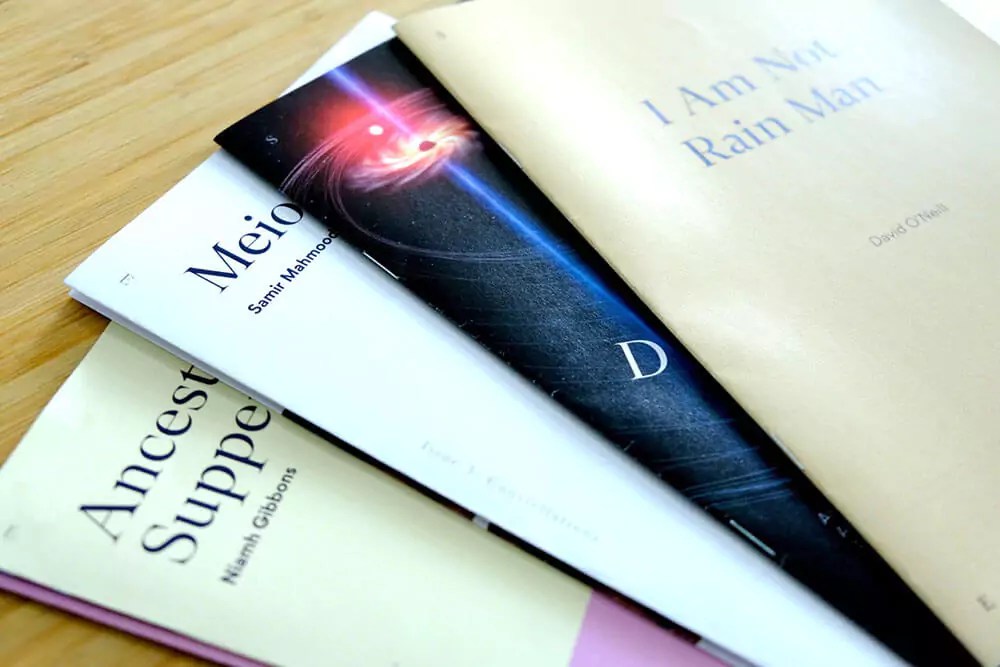
Published in SEED: Objects of Wonder, Issue 3 (June 2022)
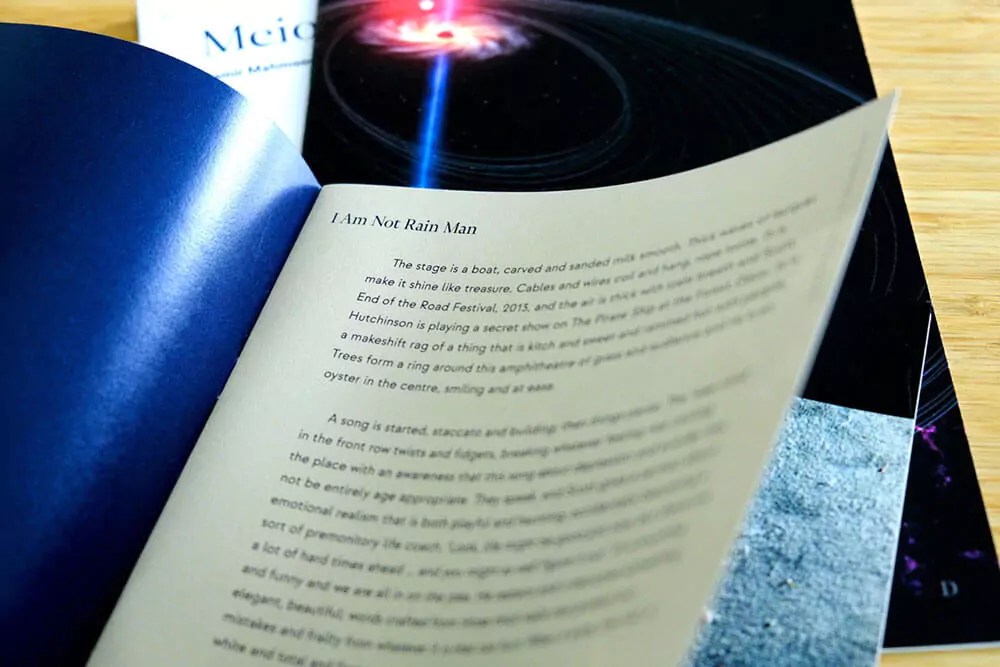
The stage is a boat, carved and sanded milk smooth. Thick waves of lacquer make it shine like treasure. Cables and wires coil and hang, rope loose. It is End of the Road festival, 2013, and the air is thick with the salty breath that comes from warms cans and fast food. Scott Hutchinson is playing a secret show on The Pirate Ship at the Forest Disco. It is a makeshift rag of a thing that is kitch and sweet and rammed hot with people. Trees form a ring around this amphitheatre of grass and audience and he is an oyster in the centre, smiling and at ease.
A song is started; The Modern Leper. It is staccato and building until suddenly it is not. Things pause. The “wee child” in the front row twists and fidgets, breaking whatever feeling was circling the place and Scott, with an awareness that this song about depression and suicide may not be entirely age appropriate, is a mix of nerves and giggles. They speak, and the musician gives a sermon about emotional realism that is both playful and haunting, accidentally becoming a sort of premonitory life coach. “Look, life might be good just now, but there are a lot of hard times ahead… and you might as well figure it out”. It is touching and funny and we are all in on the joke. He restarts and it becomes something elegant, beautiful; words crafted from those thick walls that protect our mistakes and frailty from whatever it is that can hurt. When it ends, the roar is white and total and fierce.
Unfortunately, I don’t know what happened next and I don’t know if the child enjoyed themselves past this tiny, tender interlude. Despite every fragment of these words being stored deep in my memory; their sounds and syllables attuned to muscle memory, it never goes further. I wasn’t there. I have never been to that festival. Instead, I live these few minutes through a screen and when it has finished, I click on a small anticlockwise arrow with Repeat written under it. The introduction and the chords and the laughter, again. The hope, again. The elation, again. It feels sharp and bright to my senses once more. Though I have watched this video far more often than would be considered typical, endorphins crash around beneath my skin as though it is brand new.
This exhausting balance of interest and comfort, of months spent decoding and observing and secretly lining each breath and word and movement into narrow, cognitive pathways, is not new however. It is an automatic response, a desire to repeat and study, to learn the intricacies and pivots of interaction from a safe distance. Controlled by something savage and insistent, it is a language that demands fluency. Recently, I have started to recognise this with something closer to clarity. A pattern or mosaic that has been covered over by moss and grass and time. While it hasn’t always been The Modern Leper at End of the Road, it has always been other, similar things. Much of them make me wince.
It is rewinding crackling cassettes to burn rollercoaster basslines into my synapses. It is snapping the spool on a worn out VHS; plastic and film finally wheezing into retirement. It is friends sighing and friends rolling their eyes and friends finally leaving with sweet little mutters under their breath as I talk them through hours of music. But then, joyously, it is the internet too, a goldmine, ocean deep with interviews and alternate takes, setlists and demos; enough for lost hours that blur closer to days that almost quench whatever this thirst is. Now it can be sixties Dylan too, wire thin and electric, or the seventies version, spun out and bitter and, well, you get the picture. These stories are insistent. They are my vision and senses; how I see and feel and understand and figure the world out and they are all there now, on tap, for free.
The psychologist said that “If it had been something else; trains maybe, people might have noticed sooner” and in the days that follow this meeting, I feel many things; hope and enlightenment and grief and anger. I am angry at the people that didn’t listen, or heard the wrong words. I’m angry at the people that laughed or laughed it off. Mostly though, I am angry at not being weird enough, for being too boring in my obsessional repetitive behaviours to get twigged. There is no time to dwell on it though because a week comes round too quickly and she is at it again, with questions that should really come with their own shovel. I am careful to remember, to be objective about my past. Diligently, I flop large husks of myself to one side so that I am unearthed, and I bore down, eager like a drill. Every time, it is the same; this too repeats. I am worn out and bruised by pennies that drop like hail. This, it must be said, is traumatic and hilarious and revelatory. Answers, now; real, loud, clear ones. As a writer, I knew. Behind some thick mist, I really did know. It seems that the questions I was asking, the stories I was writing, themes that repeated themselves like seasons; songs of identity, of community, of memory, were the right ones after all. It’s just that they faced the wrong way as they were speaking so I only caught their echo.
Even when I was quite young, I was acutely aware that I was two different people. The external was nothing but theatre, papier-mâché that could be painted over at will. It didn’t matter. Internal; that was the real one alright. The only problem was that this internal was a geek, glitch nervous and prone to oversharing and that simply wouldn’t do. Instead, I became an observer.
Nothing was missed.
When a child got too loud or too blunt, I noticed the adults eyes darting to each other and I tried to guess what they meant. I filed it away. When I spoke for too long I noticed the subtle shift of a shoulder and knew that I had lost them. I studied body language like a historian, searching for clues to explain the remains. The internal became quieter still as layers of newness and bright, fresh costumes were poured over it. Each one tried on until I had learned its movements and memorized its lines. My way of figuring things out was to lock them away and start again, and again; rinse and repeat. Anticlockwise arrow. The internal, that sorrowful wretch, became compacted and deflated and buried and replaced.
But, sure, how could you do any of that that? You can’t lie; it’s impossible for people like you.
Lie? Course I can; easy. I have been lying since birth; pushing this peg into those round holes from forever. I have lied to be included, lied to be left alone, lied so that I would blend into a line-up, hidden and beige and deliciously invisible; and safe. I can become anything that surrounds me, adaptable and malleable. Anyway, it’s bullshit I struggle with, all faked enthusiasm and gushing. But wrap myself in whatever character was needed so I could stay afloat, or invisible, or acceptable? That’s easy.
An adult diagnosis of autism was surprising and also completely expected. There were the boxes I didn’t think I ticked whatsoever until all of a sudden, I ticked them all at once. Being adept at studying people’s actions and motives had previously been seen as my ‘strong emotional literacy’. Modelling movements and actions on others had meant that my identity was built on quicksand. But autism? Doesn’t everyone struggle? We all have interests that we take a bit too seriously, surely? Who doesn’t feel burnt out raw after a social event, or find ourselves near mute after an hour of chat, or miss cues, or mistake cues, or confuse cues, so that flirting and joking and being serious is one big queasy game of snakes and ladders where it’s impossible to know if you have rolled a six or a one, so you turn out the lights and hope for the best. Now though, I had an explanation for it all. While I was running to keep up, everyone else had only been walking. The pain of it was like glass. It felt obscenely unfair and would have done me a whole heap of good to have known all this a bit earlier than at thirty-fucking-nine years old. See, it turns out that not everyone needed those costumes, or armour, or whatever other tortured metaphor you want for navigating a neurotypical world and, despite the enlightenment and joy that comes from a sliver of self-realisation; that still stung.
Diagnosis isn’t much but also, it is everything. It is Page One of a prologue life. Until now I have learned to read a room as a forensic scientist would, pulling clues from the air, compare and contrast, match and respond. It is far from fool proof though and so, despite this, wires are crossed and things get all sorts of chewed-up wrong. I will do something tiresome, irksome, pathetic, slow or thick. In this way, I am still clockwork. These words, and the trauma they drag from the dark heat of my belly, are tattooed onto me, thick permanent rivers of ink under my skin. But diagnosis is some tiny flint spark that tells me I am not an idiot, or shushes the echoing voice that says that I have no cop on. It means that I am deeper than my skin now; I am clear, red blood and I am learning to speak new words, etchings and cave drawings, a pre-language of resilience.
That is not what you asked for.
That is not what you said.
You should have been clear.
Please say what you mean.
These new words are scary, as though my mouth cannot, or won’t, create the required shapes. They are words that should be used by an adult, not me; someone who knows what they are doing. Every synapse asks for safety, for quiet and acceptance and retreat instead. I try to push through this feeling, to accept that life is indeed tough sometimes and to finally begin to figure it out. It is feint and shallow and new, this thing, this… advocacy. The word makes me laugh. What have I become? Am I an advocate now? It’s not a great career choice, I think. For a start, I have no social media page and don’t like my photo being taken.
Despite this, I am deciding to look for the positives. They are there alright. A lamp has clicked to life, casting dim yellows and oranges. I have been reintroduced to that glitchy, odd internal and it feels like the right place to grow from. The light still catches me off guard though, and my eyes need time to readjust. I am finding out about myself in real time, like speed dating with your own disability. Now though, instead of hiding and instead of fear, there are choices. I can ignore the dress-up box and separate myself once more. Two piles laid out in front of me; what I am and what I most certainly am not.
I am clumsy,
and passionate,
and disorganised,
and passive,
I am not Rain Man,
I am terrible at Maths,
and despite a ‘diagnostically relevant’ level of literal thinking, I can do sarcasm and irony.
*
“I know. I know… He knows, it’s fine”. An apologetic sweep of his hand and Scott Hutchinson restarts the song. “You might as well figure it out”. Accepting your disability is frightening but liberating because now I can allow myself to press repeat without needing headphones to hide it and it may not be much but currently, that is as close to figuring it out as I have gotten. It is there still, this video, safe and rewarding on the internet. A language of ones and zeros, neat and ordered on a server somewhere, filed by category. I still do not know what happened to the kid after the song ended.
First appeared in SEED: Objects of Wonder, Issue 3 (June 2022)
 David O'Neill